26,589 Words and Counting

What the Other Side of NaNoWriMo 2015 Looks Like

chrispine-01-01-01

I created a meme. #sexyguilttrip

Well, I made it halfway. Actually, a full 1,589 words over the halfway marker, before 11:59 p.m. on November 30th. Life did manage to sneak in again, albeit with significantly less intensity than last year (my attention-sucking fur monster is now almost 2 years old, so there was a big decrease in barking episodes and chewing incidents and general furball craziness).

While I am disappointed that I did not “win” National Novel Writing Month by hitting 50,000 words in time, the most pleasantly surprising aftereffect – one I was hoping might happen but was certainly not expecting would result in this much joy – is how much in love I’ve fallen with my story.

I know… that sounds weird. But I have to think that other authors agree with this description of this feeling. It’s love, plain and simple.

You find yourself voluntarily staying in on Friday night because you want to know what happens, what those blank pages are going to say on Saturday morning.
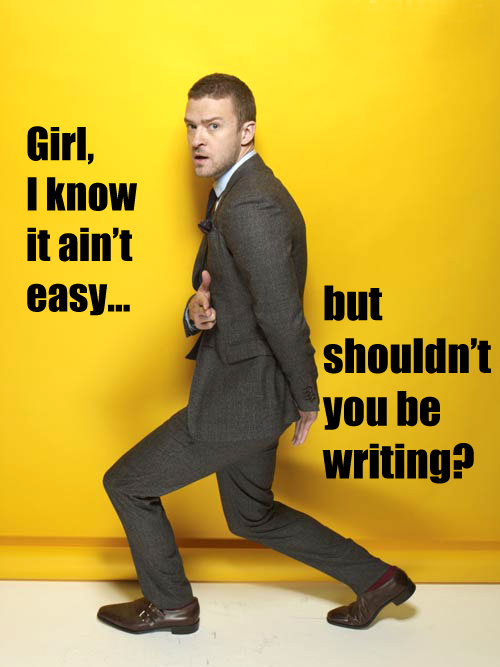
JustinTimberlake

Seriously… it became a thing. Check my Instagram.

You find yourself thinking like your characters, puzzling over mundane life decisions in the context of “What would So And So say/do/act in this situation?”

You start rooting for the people you’ve created, when you realize you’ve written them into actual, independent-thinking human beings.

You’re both exhilarated and terrified when you tackle certain scenes because you have a fantastically complex and beautiful picture in your head of what is happening and you’re beyond afraid that you will never be able to translate what you’re seeing into words that allow other people to comprehend the fantastic complexity and beauty.

You’re desperate to know how your story ends, because you’ve invested a piece of yourself into the worlds you’ve built and the characters you’ve gotten to know; and even if you’ve outlined the shit out of your plot, you still have the nagging thought in the back of your brain that nothing is certain, and this whole thing might not turn out the way you expect.

You’ve found it: your voice, your stride, your confidence, your groove, the story you were meant to tell.

JonStewart

Possibly my favorite thing I’ve ever made, ever.

So I’m merely extending my NaNo deadline. I’m not ready to leave the world of The Bearers. For those of you who succeeded in hitting 50K, I am in deep and true awe of you. Well done. For those of you in my shoes, the pressure is off (slightly)! If you’re in love with your story, keep going. We’re the people who were brave enough to attempt a novel in a month. One month! One! NaNoWriMo opens up a multitude of doors for people. It’s up to us to choose to walk through them.
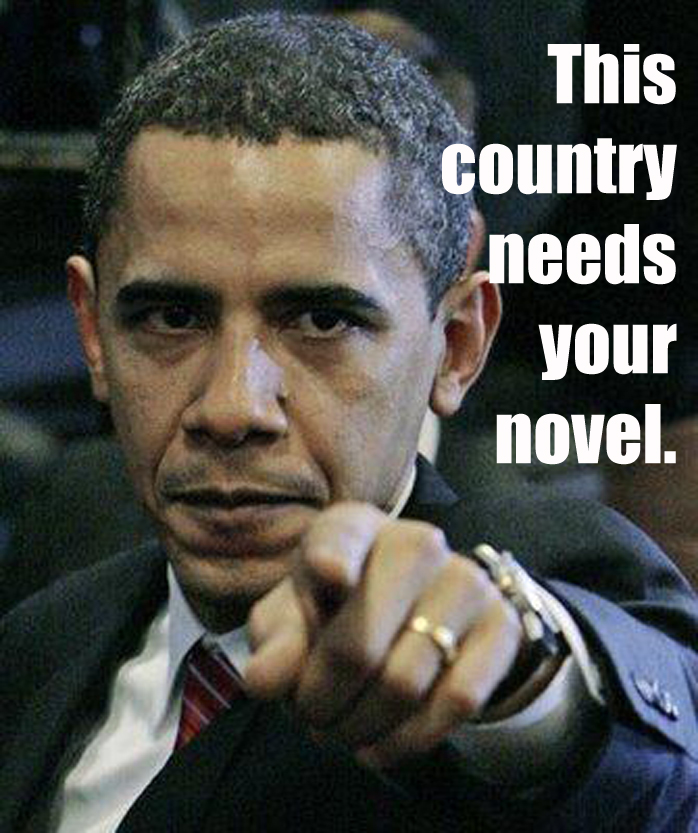
Obama

Thanks, President Obama.

December also marks a return to some shamefully neglected projects I’d left hanging in lieu of this crazy NaNo venture. With my fabulous friend and editor Kim’s expertise in all things prose, I will be completing a second edit of my memoir of Tanzania, The Red Earth Sings Beneath Our Feet, with the intent to release it in early 2016. More to come on that front! If you’re interested in learning more about the organization that made my experience possible, visit www.crossculturalsolutions.org.

I’m also hoping to release a second poetry collection, called Notes from a Bar Napkin, inspired by (you guessed it) the writing prompt of the same name that I’ve posted from time to time on this blog. There are plenty more where those came from. Sometimes I think I have to be slightly toasted to write poetry at all, let alone something that’s reasonably good enough for somebody to want to read. In any case, it’s a fun project and I’d love to share the fruits of my drinking habit with anyone interested.

So, I wish boatloads of inspiration and creative energy on y’all. Here’s to the writers of the things that people read!

Write on!

picard

BLOG HOME

Your book needs a cover.

laptop-819285

This royalty-free photo is brought to you by Pixabay.

It’s National Novel Writing Month, AND I AM EXCITED.

In the spirit of the month, late last night I found myself wandering the cavernous digital hallways of Pixabay, searching for stock photography to use for a prototype book cover for my NaNoWriMo novel, The Bearers. If you don’t know Pixabay (most of my graphic designer friends do), I suggest you get to know Pixabay. It’s a wealth of high-quality royalty-free images you can use without penalty for just about anything, including commercial use (see: book cover art). There are plenty of stock photography services out there (Shutterstock is a big one) but a lot of the time you have to pay a membership fee. I’m mentioning Pixabay because it’s 100 percent free to use.

Yes, if I was going to be sitting in front of my computer at 11 p.m. last night, I probably should have been writing. Instead I decided to exercise another creative outlet: graphic design. (This one’s more like a hobby for me, and I’m honestly not very good… still learning the fundamentals. If you want to see real dedication to the craft of graphic design, check out my friend and superstar Karli Foss’s stuff. She is the terrific artist responsible for crafting the perfection that is the cover artwork of my Tanzania memoir.) My late-night graphic design experiment led me to think about what goes into creating a good book cover, if you’re going to design your own. I highly recommend going the professional route if you can afford it, especially if you have a superstar graphic designer friend. But if you are going to give it a go and design a cover yourself…

Ultimately, in my opinion, you want your cover art to do two main things:

1. Look good.

Straight up. You want the elements of your cover art – images, text, etc. – to have a cohesive, attractive balance. I always find that less is more; keeping it simple and clutter-free is one of the best approaches you can take with a cover. Use fonts that are easy to read (avoid Comic Sans and Papyrus like the plague) and really think about what text you need on your cover. Be sparing with text. Treat your images with care. If you don’t really know how to use Photoshop without it being painfully obvious in the end result, just don’t use it.

Of course we judge books by their covers. It’s the very first impression of your story that a person formulates, and terrible cover art scares away readers before they even open your book. Do you want to tell me you’d take precious hours out of your week to read any of these books? Or these? (Real book covers, by the way.) Maybe you would, I don’t know. That is a whole other set of issues entirely.

2. Tell something about your story… but not too much.

You don’t want your cover to mislead readers. Keep it true to your genre (no robots on the cover of a historical romance novel… unless… nope, won’t go there). Avoid trying to be too avant garde with your concept. Covers that border on the slightly abstract or vague are fine if and only if they contribute to the narrative you’re trying to tell. You don’t have to give the ending away or even show a scene from your book on your cover; that said, a cover with artistic elements that harmonize with the content of your novel (or even just the summary on the book jacket) will draw readers in, if they are able to make that association before they read your book.

This is definitely a personal preference, but one of my favorite examples of cover art is the cover artwork for Gregory Maguire’s books. If you don’t know Gregory Maguire, his novels are reworkings of traditional fairytales, often from an antagonist or auxiliary character’s perspective. (He’s the author responsible for Wicked: The Life and Times of the Wicked Witch of the West, which eventually became a hit Broadway play… you might have heard of it.) The artistic styling of his book covers has become almost a brand, and the covers paint a clear picture without giving the entire story away. For examples of slightly more abstract covers, here is a great photo gallery of “The Best Book Covers of 2015 (so far)” by Frannie Jackson of Paste Magazine. Not on this list, but still an example of a simple cover at its finest, is ROOM, by Emma Donoghue. These covers may not give the story away, but they still tell the story. They tell potential readers SOMETHING about what they will find inside.

Not sure? Find help.

There are numerous articles out there in the Interwebs with tips and tricks to designing a stellar book cover. A lot of them are very thorough, and most of them give you the same basic advice: keep it simple, avoid certain pitfalls (there are a lot of lists and examples out there), and don’t use images from Google search.*

*The last point is extremely important. If you don’t take anything else with you from this blog post, remember this one. If the image you find belongs to an artist or designer and the image has been appropriated without their permission, that is stealing. Even if you found the image on a secondary site, if it wasn’t attributed to the image’s owner, you can be held liable for copyright infringement. Don’t learn this the hard, expensive way. Use Pixabay.

And of course, ask your friends. Definitely ask your graphic designer/superstar friends. Ask strangers on the bus. Ask anybody what they think. Feedback is important. Look at it as a free focus group study. You’re doing research. Come at it objectively. Use any criticism you receive constructively, and don’t take it personally. Knowing what even a random sample of people think of your cover is invaluable information to have at your disposal. It allows you to make the best possible decisions about marketing your book… especially when you’re publishing it yourself. That is why I’m putting my “masterpiece” online, for all to see.

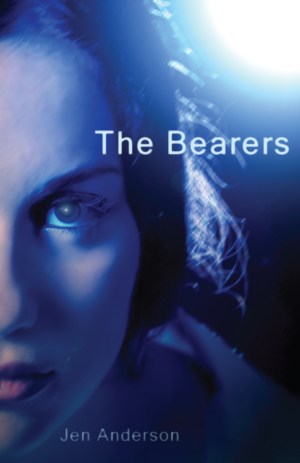
So here it is, the conceptual cover art for my NaNoWriMo novel, The Bearers.

© 2015 by Jen Anderson. All rights reserved.

© 2015 by Jen Anderson. All rights reserved.

I’m currently using this on my website and on my NaNoWriMo novel page, but it’s by no means the finished product.** I love the simple image of a person who resembles one of my main characters. For context, I may inset a small, faint illustration of an important location in the story, in one of the corners. Please feel free to shoot me an email and leave your feedback… I welcome feedback! I crave feedback. Help.

The original subject is a nameless lady in a free Pixabay photo, with absolutely no relation to Kristen Stewart (to my knowledge). I was worried this would read a little too Twilight, but ultimately it’s just a prototype cover. I would like to know if there is too much resemblance to Bella Swan before I market this image too much or go ahead and print 500 books with it (that’s way, way down the road, of course). On second thought, I’d certainly be MUCH better off having Karli do it.

**2/4/17 UPDATE: Since this post, I’ve actually changed the cover art for The Bearers, to a slightly retro-style cover design that faintly reflects the science fiction book covers of the 1970s and 1980s (which have been an endless source of inspiration for me).  You can view the new cover art here.

BLOG HOME

The November Gauntlet (or, NaNoWriMo 2015): Day One

It begins!

12108269_10101266218116136_1377477318119239925_n

Photo by Jen Anderson (all rights reserved).

I’m ridiculously excited this year, after the learning experience (see: procrastination debacle) of National Novel Writing Month 2014, and here’s why.

First, a quick recap: National Novel Writing Month takes place November 1-30 every year, where writers of all publication status come together from across the globe and form a writing community of participants that are each focused on one crazy primary task: to write 50,000 words of a new novel by the end of the month. There are a number of preparation tools, webinars, forums and other support resources offered throughout the month, and participants can choose their own pace, and methods, and level of active participation with others in the community. The end goal, of course, remains the same: 50,000 words. I attempted NaNoWriMo last year, and failed quite miserably. This year will be different.

NaNoWriMo Prep

NaNo writers, according to the NaNo Powers That Be, tend to fall into one of two categories: Pantsers and Planners. But of course, as we are all wonderfully diverse human beings, there is a spectrum.

The laissez-faire-leaning Pantsers head into the month of November with relatively little (if any) thought to outlining, character development, or world-building. They start with a literal blank slate on November 1st. In some ways, I wish I could do it that way, because what freedom it must be, to be along for the ride as the journey starts (as opposed to steering the ship. Somehow, I’ve moved to a Ship/Voyage Analogy, which I feel better about. What kind of emotional baggage am I creating with “Gauntlet”?). I digress. The hardcore Planners, by contrast, bring to the table at least some tools they’ve constructed in the preceding months. Character profiles and/or outlines are common. World-building worksheets can be helpful. This year, I have all three.

Last year I was a Pantser. I had an idea that I loved and a world that I’d built, but hadn’t thought much about my characters or the story I wanted to tell within that world. Result? A really nice little outline and 7,000 words that were okay. Now that I’ve had a year to get to know (in a sense) who my characters are, I have a pretty good idea how they’ll react to each other when I throw them into the beautifully-strange-yet-impossibly-dangerous scenario that is my plot outline. I created a writing “soundtrack” (a playlist of songs I play to visualize certain scenes in the plot… I KNOW I’m not the only writer who does this). I spent the last few months giving the “elevator speech” version of my plot summary to friends, family, anyone who would listen, to gauge reactions. You can get a sense of what I’ve been telling people if you visit the project page for more information. In a lot of cases, the elevator speech (a minute or so of describing the plot) turned into an hour-long conversation about the particulars of the world I’d built, who the characters were, what they were to each other and what I was planning to do with them (see: to them). That interest made the writer in me jump around and pump her fist in the air. Where the story is concerned, I’m feeling pretty damn ready.

nano2015day1-01

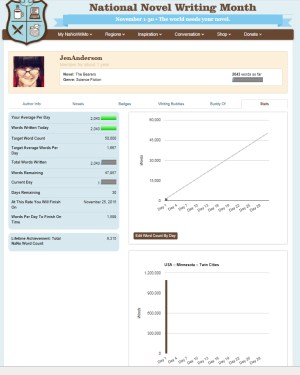
Jen’s NaNoWriMo 2015 stats after Day One (November 1, 2015)

To succeed – or “win” – at National Novel Writing Month, the NaNo Powers That Be give you a decent amount of advice, support and guidelines for success (most of which are experientially proven). One of those guidelines is the infamous Word Count (you can find mine at the bottom of the Home Page of this website). This tool allows you to update your daily cumulative word count, and then adjusts the stats for you: for example, how many words per day you need to average for the rest of November to hit at least 50,000 by the end (generally, this is 1,667 words per day, and is adjusted depending on the word counts you post on preceding days). The stats page was a significant road block for me last year. I’d catch myself staring at the little line on the graph, willing it to move at a northeasterly upward slant, while the early dredges of my novel sat open but untouched in Microsoft Word. This year, however, I’ve decided to give it the attention it deserves: one visit per day, at the end of the day, when I plug in the new numbers.

The last essential fact to understand, when attempting NaNoWriMo, is that winning it is HARD. Just hard. Life happens, hugely and frequently. Work, kids, pets, etc. can get in the way of 1,667 words per day, much easier than you think. Last year, I had a 40-hours-per-week job and a new puppy who quickly snapped up the remaining evening and weekend hours. Committing to a NaNo win takes more dedication and discipline than I was prepared for, especially as a Pantser. This year, armed with my prep tools and with a 20-hours-per-week work commitment (the pup is still a massive time-suck, but she’s trying to be a lot better about it).

NaNoWriMo 2015: Day One

jens desk after Nanowrimo 2015 day one

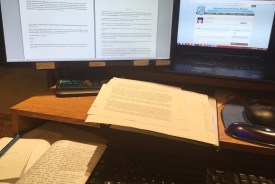
Day One: the aftermath.

After today, Day One of NaNoWriMo 2015, I know for a fact that – for myself and with the prep legwork I’ve done – hitting the daily word count quota is entirely possible. As I was writing this afternoon, I’d gone 500 words over my daily quota (1,667 words) before I’d even noticed. I’m heartily reassured by these events. I feel good knowing I have a strong story outline and positive feedback in my corner. Where the ability is concerned, I’m feeling more than ready. And beyond the capability aspect, win or lose, 50,000 words or more, or less… I’m just plain excited to tell this story.

To everyone who is participating in this year’s National Novel Writing Month and would like to connect, you can find me at http://nanowrimo.org/participants/jenanderson. If you have not yet signed up (it’s not too late!) or would like to learn more about NaNoWriMo, visit nanowrimo.org.

BLOG HOME

NaNoWriMo 2015

I realize an update on my projects is long overdue, but first:

12052367_10101258378087616_993245048235675428_oWant to jump off the proverbial cliff with me? Your future novelist self will thank you.

Click on the image above to visit the official site of National Novel Writing Month. You can create an account for free, get tips/tricks/support from fellow novelists a.k.a. cliff jumpers, and track your word count through the month of November.

50,000 words in 30 days. Sound impossible? Let’s see what happens!

If you Facebook, click here to join the Event for additional updates and information.

I’ll be tracking and logging my status in a couple of places. If you’re interested in checking in on me, visit my NaNoWriMo Author Page, or check out The Bearers summary page here on my website.

BLOG HOME

Writing amidst distraction, writing beyond excuses.

(Or: An ode to a typewriter.)

(Or, or: Buy, beg, borrow or steal a typewriter. Do it.)
Get one.

Get one.

I’m going to be brutally honest with my own self in this post. I’ve been terrible as a writer this month. I can count on one hand the number of times I sat down and focused and wrote more than a page of words. This includes my grocery lists. I’ve thrown out a sentence of new stuff here and there, but the primary focus has been on editing my travel memoir for publication (which, yes, has been pushed back and then pushed back again). The thing is, lately there’s always a reason for avoiding it – dog, work, cleaning, nap, writer’s block, whatever. Excuses.

I recently came back to my hometown in Minnesota after six years in Tempe, Arizona. I aim to stay in the tundralands awhile. The four-day cross-country journey could have provided some unique inspiration, had I not been driving twelve-hour days with a wriggly 70-pound puppy and all of my shit in the backseat, with barely enough time to eat a gas-station meal before passing out in the next dingy hotel room in the next town, in the next state over. Excuses.

Arriving home was another unique opportunity to write what I was feeling, from moment to moment: who hasn’t moved home after a long hiatus to find it unfamiliar, to find yourself a stranger even to members of your own family, unsure of your place in the place you grew up? It could have been a goldmine of inspiration. But there were jobs to hunt, and a 70-pound puppy to acclimate, and trashy daytime TV to watch. More excuses. And in between Live with Kelly and Michael and afternoon DIY programs on Home and Garden network, when there might have been a space to fit in a page or two… hopping onto a computer to use Microsoft Word, for me, has presented its own unique set of built-in digital distractions. (I curse you, Facebook. I CURSE YOU.) Hell, I haven’t even touched this blog, mainly because I was embarrassed I had nothing exciting to report, no status updates on any of my projects. Nothing new to say.

Excuses, all excuses. And not even good ones.

It took me two solid weeks of this – the procrastinating and avoiding and Facebooking – before I remembered the antique typewriter that was hidden away somewhere in my closet, where my mother had stuffed my old prom dresses, graduation gowns, and crumbling boxes of childhood memorabilia. I had found the typewriter at a garage sale, one summer when I was home from college, more than a decade ago. Forty dollars spent – a lot of money for an underemployed college kid and summer-employed day camp counselor – for a thing that would largely resemble an oversized paperweight and/or doorstop for the next ten-plus years. At the time, I bet I thought it was just an impulsive purchase, an antique whim… but now, I believe that something in me, something visceral, understood the truth in my future self and fought for it.

One week ago, feeling slightly depressed and completely aimless, desperate for a sign that I hadn’t forgotten how to form coherent thoughts on paper, I unsnapped the metal clasps that held the lid on the bulky protective case. My typewriter is an antique, a Remington Noiseless Model 7. Before I struck a single key, I did the research; my machine was manufactured shortly after Germany and Japan ceded their intentions of world domination. It is not travel-friendly: a solid lunk of metal with the heft of iron or an equally heavy alloy, and sharp yet delicate moving parts. The white paint that fills in the engraved trenches on the black plastic keys, to reveal the letters and numbers, is chipped and faded; some of the letters’ placements on the keyboard I hit only from the muscle memory of my fingers. There are rust spots in places; I wouldn’t know how important (or not) those places are, much less whether they could be replaced in the event the rust has eaten through some vital mechanism.

In spite of all of that, it still works.

When I’d located it, I quickly Googled “typewriter ribbon,” and imagine my surprise to find that there is still a market for typewriter-using writers (a.k.a. hopeless romantics, a.k.a. writers at the end of their rope). My universal ribbon was waiting in my mailbox a few days later. With the corresponding manual long gone (I don’t think the Model 7 even came with one, a casualty of the phenomenon of buying someone else’s “junk”), I decided to just go with it. Loading the spools was oddly natural. Things fit into place because of my hands but more importantly just because they fit, and when I loaded a sheet of paper and hit the first few keys, a mere test run, something happened, and I was off. Things ceased to exist outside of the clack of keys and the occasional bell-ring ding of the line break. No Kelly and Michael. No cell phone. No social media. Nothing but the sound of metal hitting ink ribbon hitting paper, and the sound of the story unfolding from my head.

Twenty minutes and five pages later, I stopped. But really, I will not stop. Thanks to a 70-year-old hunk of iron, I found my stride again. Removing myself from the siren call of modern technology somehow also lifted the fuzziness of self-doubt, and even twenty minutes renewed my confidence to write, and at least attempt to write well. And for those of you who find yourselves in a similar predicament – wrestling with your own day-to-day distractions, or simply craving a break from the bombardment of digital chaos that floods your screen every time you log on to your computer – that 40-dollar “paperweight” at your neighbor’s yard sale or the local thrift store might just be worth it.

BLOG HOME