Part One: A Love Letter to Edinburgh

Edinburgh is a city of easy first impressions.

My first impression of Edinburgh was of darkness. The sun sets early in November in Scotland. My second impression of Edinburgh was one of welcome, and even on some level a strange familiarity with my surroundings. We arrived at our hotel, Ceilidh-Donia, folded cozily into a Midlothian neighborhood of buildings similar in appearance, with their peaked roofs and worn stone facades. Of course, none of this we saw upon our arrival. My cousin Emily and I were exhausted, having spent much of the last 18 hours either in the air or between planes. We united in Dublin for the last leg of our journey, and by the time we landed on Scottish soil I had lost any concept of time, having leapfrogged over several hours into the following day from my departure. By the time we landed at the doorstep of our hotel, I simply knew that it was approaching evening, and we had arrived.

Half-asleep, and as the handsome soft-spoken ginger-haired desk clerk checked us in, I noticed an adorable dog – mostly white with mottled patches of black and brown, and wearing a harness that read “I’m deaf” – seemingly frozen at my feet, her gaze fixed intently on something just beyond my peripheral vision. I followed her line of sight and, to my absolute delight, saw a yellow ball perched between my foot and the counter. The universal dog language: “Please play with me.” I felt a momentary pang of homesickness for my dog Layla, but with one tap of the toe of my boot, we were in the middle of a game that my new friend was determined to continue for as long as possible. Which apparently, was not long enough, as she stubbornly decided to plant herself in the doorway to the stairwell leading up to our room when we received our key.

Hauling our suitcases up two floors via an extraordinarily steep spiral staircase, we reached our room tucked under the eaves and with a view of the back garden (although we did not yet know this). First instinct was to bury ourselves into the soft beds for a nap, but we obstinately avoided this temptation, worried about the creeping effects of our long journey. Instead Em and I stepped out the door into the early evening, searching for something to eat. Down Dalkeith Road a short way, we found the glittering threshold of Salisbury Arms decked with winter greenery and white lights, and inside we found a comfortable restaurant with exactly what we needed in that moment. Good food (steak and ale pie for Em, baked cod and curried risotto for me), and a bottle of Pinot noir.

The next day we emerged from slumber around 11:30am, after a much needed rest that had stolen our morning. Even with our shortened day, I can best recall it as a series of vignettes, because the afternoon was so full.
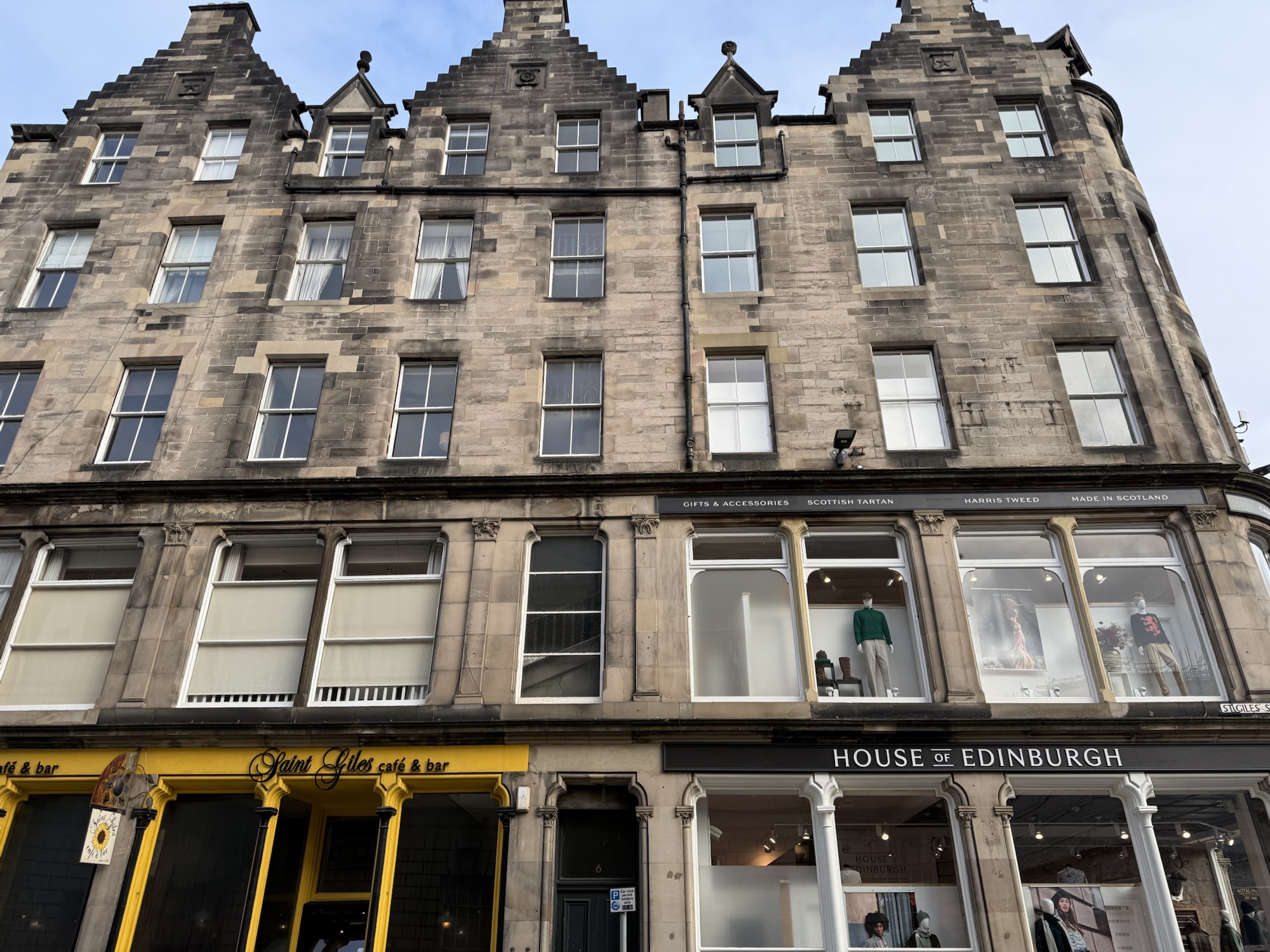
Edinburgh is an ancient city, and it is brimming with stories. There are stories etched deep into its stones. Stories in the air, mingling with the drift of rain clouds and the cries of gulls overhead. Fortunately it seems to be a city willing to share.

Brunch at Saint Giles Cafe and Bar, a tucked away but bright and sunny little cafe with sunflowers in the windows, rough stone interior walls, high ceilings, and a delicious menu of cafe food and a good selection of teas and coffees. We had a meal there, enjoying the atmosphere, and I would only learn later that the cafe is permanently closing on November 30th of this year (mere days away), after being in operation under the same ownership since 1991. We were a part of the final days of this lovely cafe’s story.

Advocate’s Close, a narrow medieval-aged alley staircase leading you from High Street up on the hill, down through and around high walled equally old buildings, and down a winding path to another section of Old Town. Edinburgh is full of these passages, called closes. How many people before me had taken these centuries-old shortcuts, walked these same stairs worn smooth by thousands upon thousands of shoes, and what were their stories?

Just a few paces away from Saint Giles, we found the News Steps, another avenue through Old Town, with thousands of padlocks lining the fence all the way down. I learned they are love locks, attached to the fence by couples seeking good luck for happy lives together. How many found their happiness? I wonder.

Everything about the Christmas Market, Edinburgh’s famous holiday conglomeration of food vendors, craftsmen-and-women, and Christmas-themed activities. The attractive and slightly nervous vendor who reeled us in to try spirits and provided us with mulled punch with elderberry liqueur, setting the joyful tone of our explorations. The lights creating a gentle and whimsical sparkle as the sun set over the park bridging Old Town and New Town. The view of Edinburgh Castle from the top of the Ferris wheel. But a truly magical part of the market, for me, was crossing paths with a fellow Minnesotan operating one of the artisan stalls. She was an expat, from Eden Prairie of all places, had studied at the University of Edinburgh, met her husband here, and had stayed for the twenty years since. I regret that I did not catch her name, but feel fortunate that I heard her story and the world feels a little bit smaller even though both of us are across an ocean from where we began.

As we climbed back up the hill to the Royal Mile from the Christmas Market, we suddenly heard the first notes of “Scotland the Brave” being played confidently on the bagpipes from High Street. The song echoed through the wynds and side streets as we searched for its source. I wonder if the piper in full regalia we’d passed earlier that afternoon had been the source of the spontaneous song.

We landed in Captain’s Bar, a half block off the main strip, taking a break from our walk back to the hotel for some liquid rejuvenation. Vaguely buccaneer themed, with a bright red facade, subtle nautical interior decor and a prominently featured selection of Captain Morgan bottles, we drank our pints of Guinness while listening to a small collective of folk musicians play live, taking turns on guitar and thumb piano, singing traditional Scottish folk songs with some Bob Dylan thrown in for good measure.

Everywhere in Edinburgh feels like it is embracing you. Keeping you warm and safe and content; this is a comfortable city.

Even the walk back to the hotel was comfortable; a gentle rain landing on my wool sweater-clad shoulders as we wandered back up the avenue toward Midlothian. On the way, we detoured to the Old Bell Inn, a cozy pub decked out in holiday festivity, where we enjoyed a late supper and more beer. As notorious as the food in the UK is rumored to be, so far it has been food that has warmed my soul, and the (vegetarian) haggis, neeps and tatties I devoured was no exception. Em and I enjoyed the quiet but jovial reunion of three older gentlemen seated next to us, old friends catching up with a couple of pints. This city feels like it is made up of old friends perpetually getting together to catch up over a pint.

There are some places where you feel immediately at ease, where you can walk the streets and feel as though some part of you either was there before, or knew you would be.

After one day, I sense that Edinburgh is such a place for me. It grounds you, anchors you to its history and willingly gives up its secrets – one by one – to keep you searching, learning, exploring. It feels like you could live a thousand lives here, but always find what you need no matter which direction you take.

We have another full day in this city; as I write this, I am sipping coffee in the breakfast room of Ceilidh-Donia, feeling the day brighten over my shoulder and marveling at the fact that the words are finally coming easily again. We have plans to climb the hill up to Edinburgh Castle today. Tomorrow, Em and I take the train up the northeast coast to Aberdeen, the rumored clan lands of our ancestors. But I do know that Edinburgh has embedded itself into my soul. It has given me a new story to tell, and remember, and love. I will forever be grateful.
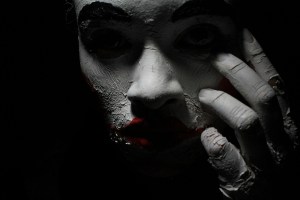

Antagonists Need Love, Too

“You don’t really understand an antagonist until you understand why he’s a protagonist in his own version of the world.” 

~John Rogers

Why a Weak Antagonist Can Ruin Your Story

Artist: isabellaquintana (Pixabay)

I’ve always loved a good bad guy.

I mean, a goooooood bad guy (or gal). The characters in your favorite books – or movies – who were so insidiously, deliciously villainous that you loved to hate them. Who had you shouting at your book in disgust and anger, but secretly a tiny part of you empathized with a tiny part of them, and that made you hate them even more.

But for every Annie Wilkes (Misery), Kurtz (Heart of Darkness), Hannibal Lecter (the eponymous series by Thomas Harris), Heath Ledger’s Joker (cemented forever into the Halls of Depraved Genius), Erik Killmonger (in Black Panther, and arguably one of the most sympathetic movie villains of recent memory), or Sherlock Holmes’ nemesis Moriarty (my favorite manifestation is by far Andrew Scott’s portrayal in the BBC’s Sherlock series) – for every strong and complex antagonist in classic or contemporary literature and film – there is also at least one flat antagonist automaton whose only motivation is that he must drive the plot forward somehow. While it is every writer’s tendency to want to focus on developing the protagonist – and I am guilty of this, too, time and time again! – a well-rounded antagonist with a relatable backstory can only strengthen your narrative. An antagonist with a driving purpose for his/her actions is far more interesting.

Artist: linolombardi (Pixabay)

“I am evil because the story dictates I need to be evil!” or “I am doing this or that to your beloved MC because I love power for power’s sake!” are certainly character motivations that lean toward the one-dimensional. On the page, a one-dimensional bad guy is one character whose flawed nature readers will certainly notice (and not a good notice), and can really make or break your story. I tend to treat my antagonists as top priority characters, sometimes giving as much if not more attention to their development than the protagonist.

That’s NOT to say your protagonist should be relegated to the Mary Sue/Marty Stu archetype, who simply reacts to everything the antagonist throws in their faces, to whom everything happens yet overcomes adversity with flying colors… although there are times where that model works. (That’s a blog post for another day!) Long story short: I try to give equal attention to writing flawed MCs as I do to write complicated and interesting antagonists and villains.*

*NOTE: To avoid confusion, since we’re talking about both in this article… antagonists and villains are not necessarily the same. While a villain will almost always fall under the “antagonist” category, an antagonist can be a villain, sure, but does not have to be villainous or evil. An antagonist can be sympathetic, charismatic and even likable.

By giving your antagonists your due diligence – creating backstory, figuring out what motivates them, identifying sources of their internal conflict as well as possible sources of redemption, injecting humor (even dark humor works!) or quirks into their personalities – you end up with a person, instead of just Evil Personified For No Reason. I recommend using the same Character Development tools you used to get to know your protagonist on your antagonist. As mentioned in my previous post on Character Development, my favorite is the NaNoWriMo Character Questionnaire.

Artist: sik-life (Pixabay)

Bad guys are quite adaptable, and even the same antagonist can change exponentially between the covers of a single book, let alone in the cataclysmic transition between a book and its film adaptation. Ever get angry about the portrayal of your favorite book characters when they appear on the silver screen?

The list of my favorite literary antagonists of all time includes:

  • Long John Silver, Stevenson’s Treasure Island.
  • Elphaba, the Wicked Witch of the West, Maguire’s Wicked (this one is controversial, because she is the villain in Baum’s Wizard of Oz, but in his prequel-of-sorts, Maguire gives us a fully-realized complicated person whose choices and motivations set her on a course we are all familiar with).
  • Moriarty (again! forever!), Doyle’s Sherlock Holmes.
  • Hot take: Mr. Rochester, Bronte’s Jane Eyre. (Yes he is a villian. Fight me!)
  • The Goblin King, Jae-Jones’ Wintersong/Shadowsong duology (please read these! Pleeeeease!).
  • Any villains or antagonists I missed who deserve to get their due? Let me know in the comments!

A few final notes:

Antagonists don’t necessarily have to be single characters. Here’s an article that outlines four types of antagonists.

Looking for more sage writing advice regarding antagonists, villainy and evil? Author Chuck Wendig wrote an article about how to do it. Trust me, this guy knows what he’s talking about, and articulates the many facets of writing antagonists far better than I ever could.


BLOG HOME


Spring Cleaning (and Rediscovery)

– For the dreamers

A few weeks ago, while digging through my family’s storage unit, I found a plastic bin that belonged to me. One of those clear plastic tubs from Rubbermaid or Tupperware or whoever owns the assembly line that makes them and ships them to Target. I hadn’t seen that bin in several years, perhaps a decade; when I moved to Arizona for grad school, a lot of my baggage (so to speak) stayed behind, and my parents became (perhaps unwilling) custodians of the crap of my youth.

Now, nearly eight years since I moved to the Southwest, and nearly two years since I returned to Minnesota, I’ve forgotten a lot of what I’d left behind. I continued to neglect that dusty and deserted storage space that held the crumbling contents of my formative young adult years.

Now, I’m eternally grateful to my parents for holding onto what I left for them to deal with, when they just as easily could have tossed it all out.

I am thankful I found that one particular bin, because I could explore it with fresh eyes and recognize it for what it was (and is)… a treasure trove worth more than the combined caches of Blackbeard, Captain Kidd, Calico Jack, and the rest of the legends of the Golden Age of Piracy.

In that nondescript plastic bin, I found a pile of my old manuscripts. 

As a writer, I’d like to think I’ve matured and grown in my craft since I started capturing my imagination on paper, since I started on that ever-exciting-yet-ever-perilous journey to write and publish a novel. However, that growth has at times been quite painful, especially since I’d all but given it up when I left for Arizona, my master’s degree, and writing of a different kind. I had all but forgotten how much I loved to dream up stories that existed in their own universes, with wildly strange and sometimes frightening characters whom I still loved, and whose glints of humanity still shone through. Stories that took me places, that I longed to share with others but of which at the same time was terrified to let go.

I placed my writing away, into the shadows, as I was required to make room for new pursuits that monopolized my time and energy. Career objectives for which I signed up to achieve. Skills and qualifications I purchased, which I was told I would need to “take me places” in practice, in actuality.

I left my writing behind as I stepped forward into a different identity, fell in and out of love in real life, and lost and remade pieces of myself in the process.
I left my writing behind as, healing from a broken relationship and not quite trusting myself, I entered into a circle of truly wonderful, supportive and creative people, enveloped by music and adventures that were rejuvenating and entertaining and diverting in the best possible way. I miss them every day, and my heart dances in anticipation of the next time we’re all together.

In the process of witnessing them pursue their own creative truths, they helped me understand that as a person who creates, it was time to start listening to my own voice again.

I began to listen. 

I found my way back to my writing when I found my way back to Minnesota. Through the continuing parade of trials and uncertainties and insecurities, through my attempts to find my footing on the next steps. My burgeoning career path abruptly coming apart from underneath me, and with the heavy burden of my educational pursuits forcing me to return to a state of pre-independence beneath my parents’ roof. Picking up the pieces once again, education and experience and career goals; pieces that don’t quite all fit together, and maybe never will.

And then I found that dusty Rubbermaid tub, full of the dusty dreams of Seventh Grade Me, and I cried. In those pages, yellowed with time and neglect, I read the soul of a girl who knew exactly what she wanted to be when she grew up, who absolutely knew what she was supposed to do with her life. I cried for a long time, mourning all of that time lost. I mourned that young girl who held such lofty aspirations, who understood the truth of herself… and who had been sitting so still, waiting, for so long.

And then I dusted myself off, and began to dream again.
In the Philosophy class I took my senior year in high school, we read The Alchemist by Paulo Coelho, and one particular theme resonated with me and lingered to this day. The idea of personal legends: that we all have true destinies that reflect our true selves, and we recognize them in ourselves when we are young, but as time progresses and the burdens of life begin to weigh us down, we forget. We leave them behind.

When (or rather, if) we manage to clear away the distractions and remember what our personal legends were to be, we are then ultimately faced with the choice of whether to pursue them, or let them go for good.

In this springtime of my own personal legend… with these tattered manuscripts in hand, and with bright and shiny new ideas at my fingertips… I’ve decided to follow it, wherever it goes.


BLOG HOME

Tasks (or, Un Résumé de la Vie)

My first task on this planet was to take a breath, and then another. And then, to fill my lungs with life and shout into the void my purpose for existing. I have not stopped since.

My second task on this planet was to obey. Mightily, I struggled with this task; heavy chains rattling a song of resistance as I fought tooth and nail against the oppressive directives of “Don’t Touch That” and “Eat Your Vegetables.” Mightily, I rebelled against the later executive orders of “Clean Your Room” and “Don’t Talk Back To Me” and “Be Back In This House One Minute Before Your Curfew.” And then, much later, from the distance of new adulthood and the separation of three hundred cell phone towers, “Be Safe And Make Good Choices.” This task has a limited shelf life, diminishing in value as the years pass, and attached is the critical conditional clause: “Unless When Confronted With Oppression Or Injustice.”

My third task on this planet was to be kind. To lift up the fallen and heal the wounded with words of strength and actions of support. The third task is the most difficult of all the tasks at times, when you are the one licking your own wounds, when you must pick yourself up after a tumble. But this task eventually takes a form much like the first. When you hold the hand of a bullied schoolmate, or sit next to the woman wearing a headscarf on the bus to shield her from verbal shrapnel, to perform this task carries the weight of indrawn oxygen.

My fourth task on this planet is to see. To open my eyes and keep them wide open. To witness the life experiences of others through a lens that does not belong to me. To stare at the bright glare of the truth, no matter how it burns through the safe protective shield of my own life experience. No matter how it hurts.

My fifth task on this planet is to listen. If you listen hard enough, you can hear music in the strangest of places. If you listen hard enough, you can hear the whispers of your childhood dreams in dark corners, revealing themselves to you again and again. If you listen hard enough, you can hear what people mean to say, even when they don’t speak out. Or even when they shout.

My sixth task on this planet is to be present. To pay attention to what is happening now, even while remembering what happened a long time ago, while imagining the happenings to come. To stand in one place, unafraid and undaunted, and be here, and belong.

My seventh task on this planet is to create. To fill the void with something other than my shouted purpose. To take beautiful things and ugly things and painful things, and forge the spark that lodges and burns recognition into someone else’s soul. To pull stories from the ether and scorch them into words onto the kindling of my notebooks. To obey the Muse. To lift up the voices, the stories, of the oppressed. To tell the truth. To hear the dreams of my own childhood whispering to me in echoes.   

This résumé will not land me a job; not in the traditional, societal sense. This particular curriculum vitae will not earn me tenure in the career field called Life; none of us live forever. But I have to wonder… in this cosmic karma machine of birth and death, work and play, waiting and doing, creating and destroying, seeking and finding, living and dying… I have to wonder if I’m hired.


Author’s Note: This piece originated from a writing prompt “My First Job” for the Waconia Writer’s Group, 2/12/17. (You can see how well I adhere to the concept of literalism.)


BLOG HOME

In this time of heartbreak and fear, keep writing.

file_000-25Writing is an escape for me. It is an escape for many of us who craft words into stories, and stories into experiences for others. The process of writing fiction has always been cathartic because it allows us to step outside of our own lives and into lives of our own imagining. Who doesn’t want to disappear for awhile into a world of their own making; where unemployment checks, past-due bills and the uncertain state of nation and world affairs don’t have an influence? Who doesn’t want to temporarily shed the weight of reality in favor of the soaring reach of dreams?

That is the intention, anyway.

The past few months have left me paralyzed. The past week alone has left me gasping for enough breath to scream. I, along with millions of people, have witnessed the rending of the seams of the fabric of American society, leaving behind something that is wholly unrecognizable, but nevertheless horrifying on an unfathomable scale. For me, events have flickered over my computer screen, over my TV screen, with painful speed, as I struggled as though underwater to grasp what exactly every new executive order means for me. For the people I love. For my friends of all walks of life. For millions of innocents I have never met but for whom my heart is shattering.

Since November 9th, I have written few words.

I’ve tried. Believe me, I’ve tried. But I couldn’t find them. I still don’t know whether I have. Certainly not enough for what has transpired at the hands of the new American president (I will NEVER say his name). I will say that there are some eerie parallels between certain recent executive orders and certain events that take place in my dystopian YA novel-in-progress. Looming conflicts with peoples from sovereign nations, the catastrophic decommissioning of environmental protections. A villain who is a vain, power-hungry opportunist whose primary “tragic” flaw, and obstacle, is his own malignant narcissism. But who could have predicted the real-life Resistance would be led by Teen Vogue and the park rangers? (Also, I would pay good money to read THAT story.)

I digress. I’ve reached an epiphany of sorts this week, as immigrant families were turned away at airports and as millions of people became fearful once again of losing control over their health. As women across the world grew more uncertain about the autonomy they had over planning their families. As arts programs were pushed onto the federal budget chopping block and as truth-tellers in the press… the “fourth branch of government” and the American public’s last line of defense… continued to be berated with threats and scorn from the President of the United States. As all of these travesties were legitimized by inaction from Congress, and as lies were turned into “alternative facts.” As things got as bad as we all feared, and then worse.

As scared and as heartbroken as I feel right now, I’ve realized that the one real power I have left is my voice. The ability to use it in unison with millions of others, as we reach out to our elected representatives. The ability to use it to educate the ignorant, to further the ideas of intersectional feminism, conservation, equal rights for all. The ability to reach people through storytelling, to document atrocities, to analyze, to critique… and also to set free the dream, to imagine a better world, to fight back against the terribleness of this one with the things I need to say. The words I must find. It costs me nothing to do this. It costs me everything to stop.

We can never stop.writersresist

In this time of heartbreak and fear, keep writing.logo

As people in power do their best to destroy everything we’ve built, keep writing.

As marginalized groups come under attack, find the writers among them and raise their voices up. We need their voices, now more than ever.

As we push on into this uncertain and definitely unprecedented future, keep writing.

Keep writing, my fellow word warriors.

Keep.

Writing.


BLOG HOME