Wait, what, it’s almost 2018 already? Hold the freaking phone…
It has been nearly a solid six months since I’ve posted something – anything – on this blog, about writing, or even not writing. For that obscene lapse in communication, readers, I profusely apologize. But a lot has happened. Allow me to share…
In which the author finds herself gainfully employed once more.
I accepted a position in county government, smack dab in the middle of my degree field, so that is the good news! (MANDATORY DISCLAIMER: All thoughts, opinions, etc. I post on this blog are mine and in no way represent my employer, whose name I am intentionally neglecting to reveal. Must keep day job and dream job separate, people! SECONDARY DISCLAIMER: And no, I’m not a spy or anything. County government administration doesn’t really require a new employee to bring with them a spy’s skill set, anyway.)
 However, the inevitable trade-off with gainful employment is, of course, fewer hours in my day/week to devote to my first love and ever-aspiring career accomplishment: publishing a book people want to read. This acknowledgement has been a devastating one, friends. But by acknowledging this new yet necessary obstacle, I have been afforded the opportunity to actually expand my creative leanings into the realm of time management. I’ve discovered there is joy in rising before the sun, brewing coffee, and diving into the world of Stormriders for an hour or so, before most of the rest of the world has any idea a new day has begun. And this is speaking as a human being who keeps a List of Top Five Activities Of Which To Glean the Greatest Sheer Delight, and includes the art of sleeping near the top of that list.
In which the author recommits herself to the completion of the book of her heart.

Once upon a time, a girl visited a land far, far away. It was many years ago, but the colors and voices and sounds and tastes of that land have stayed with her, vibrant and strong. Throughout that visit, she kept a journal. From that journal, came a story. A true story, according to the girl, but what she didn’t realize was her truth didn’t necessarily align with the truths of others. And so the girl soon realized she was left with a hopelessly personal and biased story, from the perspective of an optimistic and idealistic Western white mind. It was a story that did not tell the entire truth of the land wherein the girl worked and played and explored and rested her head for a month of her life. And the girl’s heart broke as she began to understand how close she came to harming the people and places she has come to care about the most, by making the story hers instead of theirs.
The world does not need another story of a privileged girl learning from people who look and speak differently than she does. The world DOES need to hear those people’s stories, from their perspectives. And so, the book that began as the personal tale of a voluntourist has become a journalistic voyage into the villages and neighborhoods around Moshi, Tanzania, to bring to Western attention the efforts of local nonprofits and non-governmental organizations, run by people who grew up within those same neighborhoods, visionaries working tirelessly to improve the lives of their neighbors and communities.
The Red Earth Sings Beneath Our Feet was going to be released late this year. For obvious reasons, that has been pushed back indefinitely while I rework the structure of the book and conduct interviews. But I am excited and grateful and privileged to tell this story the way it needs to be told, the way it should have been told from the beginning.
In which the author resigns herself to yet another headlong foray onto the literary roller coaster that is National Novel Writing Month.

Like my fancy NaNo mug? Get it here.
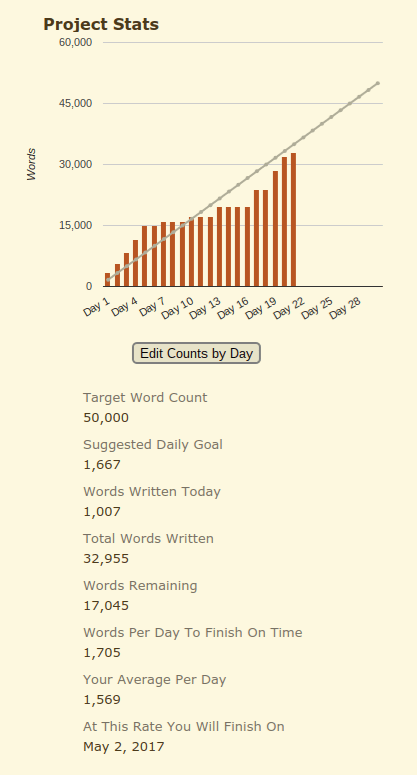
Thirty days. 50,000 words. Fifty. Thousand. I do sometimes feel a bit repetitious this time of year. You’ve heard it before. The problem is, I’ve gotten close but never actually have won NaNoWriMo. Every October, I prep and plan and post words of inspiration and encouragement. “THIS IS MY YEAR,” I say. Only, it never is.
So this year, I’m going into it a little differently. I’m taking my newfound love of early morning candle-lit writing sessions and will commit to put as many words as I possibly can into that hour before dawn. I am going to ignore the daily word-count.
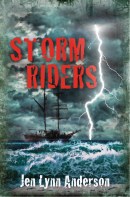
I’m going to remember, each and every single time I sit down in front of my computer, that I am continuing a journey with the characters I love and whom I miss when I’m away from my keyboard. I’m going to surround myself with music and images that inspire me and remind me of those characters and places I am trying to get out of my head and into the book. And what the result will be? I won’t know until I’m there. But whether it’s fifty or fifteen thousand words, my goal is to have a completed first draft of Stormriders in my possession by the end of November. “Winning” be damned.
In which the author signal-boosts a wonderful little group of fellow writers and dreamers.
I’m a big believer in sharing. But as a writer, sharing your work is often incredibly difficult to do. Sometimes it is flat-out painful. Criticism hurts, and even constructive criticism can sting. But critique is a vital component of any writer’s growth in their craft. So what better cure for the sting than finding others who are on the same growth journey as yourself?
Writers groups are an invaluable resource for any seasoned or aspiring author. They prevent you from writing in a vacuum. Whether you have a story you already know you absolutely must tell, or are still searching for your story, a writers group gives you a place to start. To sit down and talk about your ideas, to navigate the tricky twists and turns of the imagination only writers know about. To commiserate about the numbing void of writer’s block, and tap for feedback on the books of our hearts (yes, even when that feedback hurts).
 Fortunately, the Twin Cities, with its many celebrated arts communities, boasts dozens upon dozens of well-established writers groups. In any city or town around the TC metro, you can most certainly find a group of your fellow writer people who meet in a somewhat organized fashion at least once a month. Just in Carver County, we have juggernauts such as the Arts Consortium and the Chanhassen Authors Collective, for starters. For my part, I love the small but meaningful meetings of the Waconia Writers Group, where anywhere from four to a dozen or more writers of all ages and experience levels meet twice a month.
Writing can be a lonely experience. It’s easy sometimes to forget that we’re NOT alone. Writers groups help us remember that fact. So don’t be afraid! Find your people, find your story, and grow your writing.
BLOG HOME

 Writing a novel is an intricate, complex machine of moving parts and pieces, tasks and goals. Of the entire complex machine, to my mind there are three tasks that stand out as extraordinarily important… the foundations, the tenets, of the entire process:

 Now, I’m eternally grateful to my parents for holding onto what I left for them to deal with, when they just as easily could have tossed it all out.
 I left my writing behind as I stepped forward into a different identity, fell in and out of love in real life, and lost and remade pieces of myself in the process.
 And then I dusted myself off, and began to dream again.
 Jen Lynn Anderson
You must be logged in to post a comment.